How to Build a JEE Main Rank Predictor...
April 28, 2026
Home >> AI Agent >> How AI Agents Are Replacing Chatbots in 2026
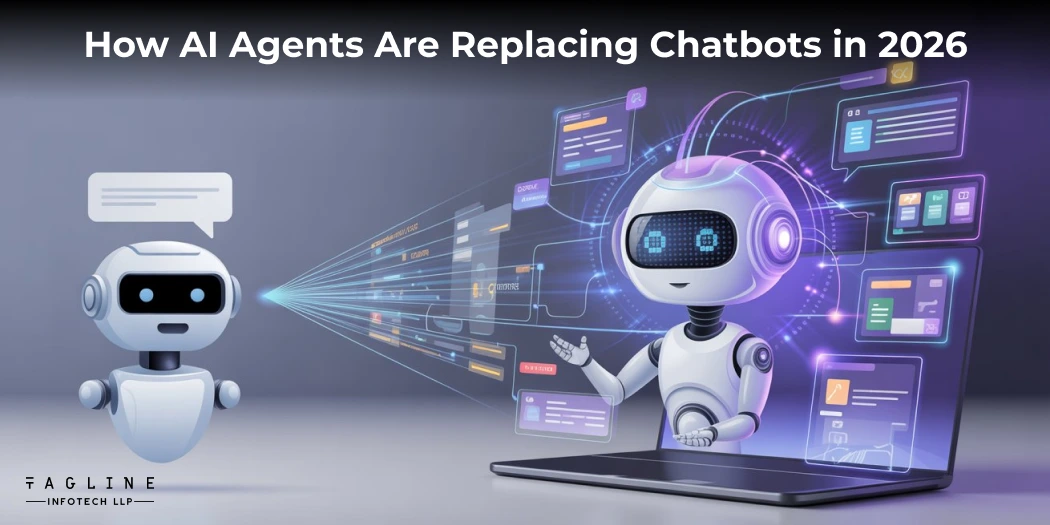
Usage of multi-modal AI agents is on the rise. In fact, Deloitte research suggests that usage of AI agents will rise from 23% to 74% in the next two years. While there are many different use cases of AI agents, customer service is one of the key aspects for every business. And this is where AI agents are now getting more traction over conventional chatbots.
This article answers all your questions as a business on the integration of AI agents for customer service functions, its use cases, and how it solves limitations of conventional chatbots.
Traditional chatbots are mostly reactive and rely on predefined scripts and decision trees to handle user interactions. These chatbots often operate with limited context. Such chatbots are mostly stateless interfaces. It resets between sessions and usually passes on more complex queries or escalations to human customer support executives.
AI agents, on the other hand, are goal-oriented. What this means is every AI agent is designed through AI Agent Development to be a reasoning engine that can plan and execute multi-step workflows. AI agents are context-aware systems that continuously analyze the environment and maintain a persistent memory across interactions.
Traditional chatbots are more like text-completion systems, and AI agents offer advanced control loops blending cognitive processing with operational execution.
Chatbots use NLP to match the user’s intent to a predefined script. At the same time, AI agents use LLMs as cognitive modules. This allows modern AI agents to reason with users and thoroughly understand queries for effective responses.
AI agents use LLMs for chain of thought reasoning, and based on it, agents decompose the high-level query tasks into smaller, granular sub-tasks. Leveraging NLP, AI agents interpret the
nuance of user queries. Enterprises can also leverage AI software development services to build agents to understand and respond to specific queries of their target audience.
AI agents use machine learning methods, such as reinforcement learning, to make better decisions. Modern AI agents don’t just use scripts to respond like traditional chatbots. Instead, they use self-reflection mechanisms to critique and fix their inputs. So, even if the AI agent fails at a task, it can change the plan and try a different way. This level of adaptability is often achieved by leveraging Machine Learning Development Services that enable systems to continuously learn, improve, and optimize decision-making over time.
Managing the complexity of user queries, AI agents often rely on orchestration layers. These layers coordinate different activities across sub-agents, which complete sub-tasks. It is an entire ecosystem of multiple sub-agents that complete domain-level tasks. A centralized orchestrator AI agent facilitates the exchange of data across sub-agents.
For example, an AI agent for research on a customer’s credit history will have to pass on the data to another agent that determines whether the customer is eligible for a loan.
AI agents often bridge the gap between users’ expectations and the results of actions triggered through the queries. Agents use robust tool integrations standardized by protocols like the Model Context Protocol (MCP) to ensure optimal results.
This allows AI agents to easily leverage different tools through plug-and-play integrations of enterprise APIs, databases, and ERPs. And it’s not like they just fetch information through these interfaces but execute end-to-end workflows to offer desired results for user queries.
Now that you know the difference between the two, it’s important to understand the key limitations of traditional chatbots.
Traditional chatbots are reactive at their core. The reliance of these chatbots on static decision trees and the lack of operational autonomy reduces their ability to complete complex tasks for customers.
Conventional chatbots often operate on “if/then” pathways and keyword matching. This is a strict logic that has trouble understanding the subtleties of the user’s question if it doesn’t fit into the programmed rules.
Unlike AI agents that can initiate actions, chatbots are purely reactive. They can’t do anything until the user tells them to. They function primarily as “stateless” text-completion systems designed to answer questions rather than goal-oriented systems designed to solve problems.
Most of the time, chatbots can’t change backend systems or run workflows that have more than one step. They often can’t do complicated tasks that need to be done across many different business systems.
Traditional chatbots have “amnesia” because their memory resets after each interaction. They have a hard time keeping track of what’s going on across different channels or over long periods of time. This often means that users have to enter the same information again. They don’t have the multi-layered memory systems that let advanced agents learn from their past interactions.
These systems don’t learn or change on their own. Developers must manually reprogram and update scripts to make a traditional chatbot better.
AI agents overcome the core bottlenecks of conventional chatbots through autonomous control loops. It’s not rigid, does not work based on a specific script, and has complete autonomy to frame responses.
Here is how AI agents solve specific legacy bottlenecks:
AI agents use LLMs as reasoning engines. This is a shift from “if/then” decision trees and keyword matching to context-aware reasoning engines. The employment of a reasoning chain of thought by AI agents allows the breakdown of complex tasks into several subtasks.
Conventional chatbots are passive or reactive, but AI agents are active. Agents use actuators to execute specific tasks like read/write operations within enterprise systems like ERP or CRM.
AI agents have a tripartite memory architecture maintaining persistence during customer interactions. The first layer is working memory that tracks the immediate task state. Second is episodic memory, which recalls past interactions for the identification of patterns. Third is semantic memory that stores empirical knowledge and enterprise facts.
AI agents operate continuously in perception-action loops. Agents monitor data streams to detect anomalies and initiate actions proactively.
Modern AI agents are often multi-modal. This means they have multi-agent systems with one orchestrator and several sub-agents. So, more complex customer queries can be handled by such agents compared to conventional chatbots.
AI agents in recent years have evolved from simple FAQ-based chatbots to fully autonomous platforms. This is why more than two-thirds of respondents say their organizations are now using AI across two or more functions. Some of the key use cases of such agents for customer support are,
AI agents in 2026 function as “Tier-0” support. They are capable of executing complex, multi-step tasks without human intervention. What this means is the use of a multi-agent system to execute complex multi-step transactions without human intervention. They integrate with the backend systems to perform read/write operations.
Agents can handle refunds, reset passwords, change flight reservations, change insurance records, and update shipping addresses on their own.
In IT and SaaS, agents are like virtual analysts who fix technical problems, check permissions, and automatically give out software licenses.
AI Agents keep track of deliveries in real time, handle order changes, and manage the whole return and refund process. For instance, travel companies use agents to make changes to reservations and answer questions about specific properties, which keeps a high containment rate.
Agents listen to live conversations and tell human representatives what to do next, remind them of compliance, trigger AI agent identity verification, or send them articles from the knowledge base that are relevant.
The interaction summaries, tag dispositions, and updating CRM records are automatically written by the agents after a call or chat, sparing human agents the tedious administrative chores.
The quality Assurance (QA) is evolving with the AI agents, whereby it is no longer random but encompasses it all. AI agents consider all the interactions rather than only 1-2% of calls to assess performance, detect compliance breaches, and discover coaching opportunities.
Such understandings are applied to identify a training deficit in an automated way and amplify human and AI agent behavior.
Anomalies are detected by the agents monitoring backend systems (shipping logs or server status). They are able to take the initiative to inform customers about a delay in shipment or service downturn and provide a solution before the customer logs their complaint.
With the further growth in the usage of AI, the customer support chatbot innovation is exploding. In particular, in the situation where the customer demands are evolving, and the necessity to automate the process of resolving queries is gaining traction, it is more practical for businesses to switch to advanced AI agents with the support of an experienced AI Chatbot Development Company like Techanic Infotech.
These agents can assist the customers in completing some major tasks depending on their queries and particular needs without human intervention. It minimizes the likelihood of mistakes in the query answers and minimizes the strain on the customer care departments. Therefore, create an AI-based customer support agent today and change customer experience.
AI agents are not fully replacing chatbots in every use case, but they are becoming the preferred choice for complex customer support tasks. Simple FAQ chatbots still exist, but businesses are increasingly shifting to AI agents for better accuracy, automation, and customer experience.
AI agents improve customer service by resolving issues end-to-end. They can process refunds, update records, troubleshoot problems, and proactively inform customers about issues. Unlike chatbots, they do not rely on scripts and can handle real-world scenarios more efficiently.
AI agents reduce the need for human escalation but do not eliminate it. They act as Tier-0 support and solve most queries independently. Human agents are involved only when emotional judgment, legal review, or complex decision-making is required.
Yes, AI agents are designed to integrate with enterprise systems such as CRM, ERP, databases, and APIs. They can read and write data, execute workflows, and coordinate tasks across multiple platforms using standardized protocols.


April 28, 2026

February 2, 2026
January 30, 2026

October 30, 2025

September 19, 2025



Digital Valley, 423, Apple Square, beside Lajamni Chowk, Mota Varachha, Surat, Gujarat 394101
D-401, titanium city center, 100 feet anand nagar road, Ahmedabad-380015
+91 9913 808 2851133 Sampley Ln Leander, Texas, 78641
52 Godalming Avenue, wallington, London - SM6 8NW